
No Meeting Without Notes
Ask anyone on a team what was decided in last Tuesday's meeting. Then ask someone else. You'll get two different answers, and neither of them will be completely wrong. That's the problem. Both people were there. Both paid attention. Both left thinking they understood what was agreed. And yet somewhere between the conversation and the work that followed, the versions diverged.
This is not a memory problem. It's a documentation problem. And it's completely avoidable.
The rule is simple, the discipline is not
No meeting without notes. No exception for short calls. No exception for informal chats. No exception because it felt obvious or because everyone was in the room. The rule applies to a ten-minute daily standup just as much as it applies to a three-hour planning session.
Most teams treat meeting notes as optional. Something you do when the meeting felt important enough. The problem with that logic is that importance is only obvious in hindsight. The quick call where a direction got changed, the hallway conversation where someone said "let's just go with option B," the sync where a deadline shifted by two weeks. None of these feel like moments that need documentation. Until three weeks later when nobody can remember what was actually decided and the team has been building in two different directions ever since.
What good notes actually contain
Most meeting notes are useless. A list of topics that were discussed tells nobody anything actionable. Good notes contain three things: decisions that were made, action points with a clear owner and a deadline, and enough context that someone who wasn't in the room can understand what happened and why.
That last part is the one most teams skip. Context is what gives notes their longevity. A note that says "we decided to use the new API" is worthless in six months. A note that says "we decided to use the new API because the old one doesn't support the pagination we need for the mobile view, and we accepted the migration cost as a tradeoff" is still useful in a year.
Recording every meeting changes the game
Writing good notes manually is hard and slow. It pulls the note-taker out of the conversation. It relies on one person's interpretation of what was said. And it still misses things.
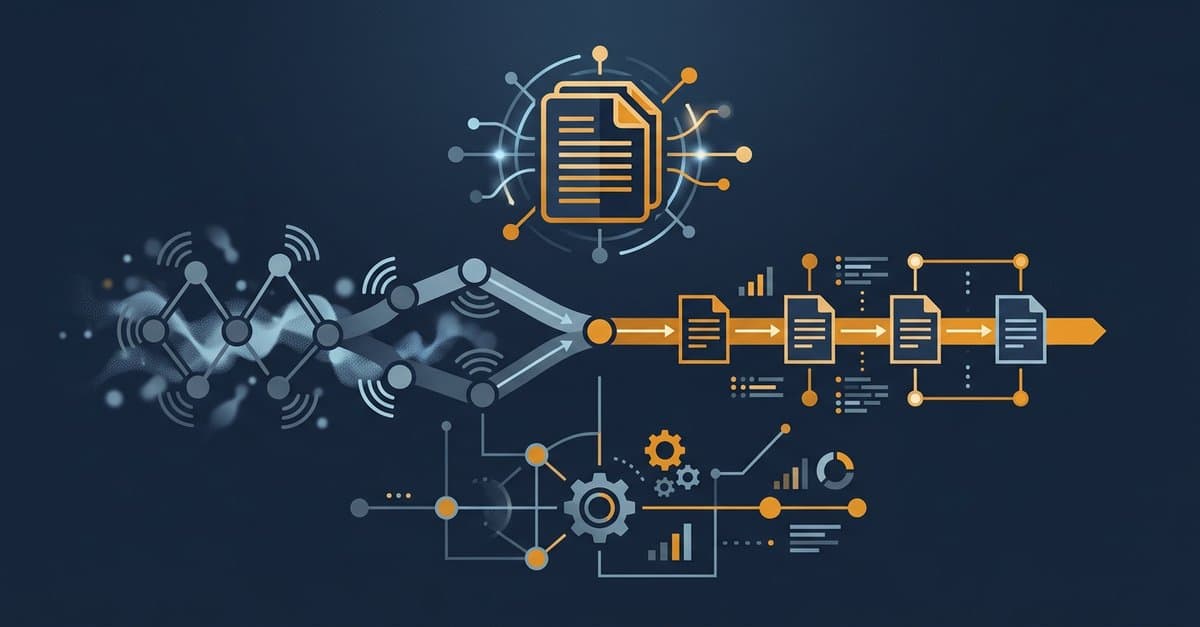
The better approach is to record every meeting and let AI handle the summary. Record, transcribe, summarize, extract action points. The result is a structured document that reflects what was actually said, not what someone remembered or interpreted. It takes a fraction of the time and produces better output than anything written by hand under time pressure.
The tool doesn't matter much. What matters is the habit. Every meeting gets recorded. No exceptions. In a remote setup this is straightforward. In hybrid or in-person contexts it takes a bit more intention, but the discipline is the same.
There's a second reason to record everything that goes beyond the immediate summary. Every recording is data. You might not know today what you'll do with it tomorrow. Identifying decision patterns over time, training internal models on how your team thinks and communicates, onboarding new team members with real conversations instead of sanitized documentation, auditing why a product decision was made six months ago. The teams that record consistently have that option. The teams that don't have lost it permanently. Think of it like a data lake: collect first, and the use cases will follow.
One source of truth, not five
The recording is only as useful as where it ends up. Notes that live in someone's personal app, in a private folder, or scattered across email threads are almost as useless as no notes at all. The point is not to document, the point is to make that documentation available and searchable for everyone who needs it.
This means a single, central place. One system where every meeting summary lands, where every decision is findable, where action points can be tracked across conversations over time. When someone asks "what did we decide about X three weeks ago," the answer should be a search query, not a memory test.
That central place also becomes the foundation for everything downstream. Product questions get answered by referencing what was discussed and decided. Planning sessions start from what is already documented rather than reconstructing context from scratch. And AI that is connected to this system can use it directly: generating tickets from decisions, surfacing relevant past context before a new meeting, flagging when a current discussion contradicts something agreed upon earlier.
Notes as the connective tissue of a team
When IDEs, project management tools, and documentation systems share the same source of truth, the loop closes completely. A decision made in a meeting flows into a ticket, which flows into the code, which flows back into the documentation. Nothing gets lost in translation because there is no translation. The conversation and the work are connected.
This is what it actually means to have a single source of truth. Not a wiki that nobody updates. Not a Confluence space that's six months out of date. A living record of what the team decided, why, and what happened next, fed by every conversation the team has.
How fast that information travels through the team, how quickly decisions reach the people who need to act on them, matters as much as the documentation itself. The communication infrastructure you build around your meetings shapes how useful the notes actually become. That's a topic for the next post.
More articles
The Fastest Way to Speed Up Your Team Is to Do Less
OKRs add overhead without fixing the real causes of a slow team. The actual answer is saying no, delegating decisions, deleting ruthlessly, and protecting core competence. And making sure management holds the line.
Why Standards Are the Wrong Tool for Hiring
The definition of standard already indicates it wasn't made for hiring. On complicated vs. complex, restriction of range, and why the solution lies with the hiring manager.

The Intent Interface
Eric Schmidt called language the universal interface to AI. I want to extend that idea. The full picture is one unified Intent Interface, a single point of intent that controls all your tools through a shared brain.